Date and Time – 2026:08:22 16:41:34
In June 2026, I travelled around France visiting its officially designated Most Beautiful Villages. Although the itinerary was rather demanding, I managed to visit every village that had joined the association since the previous summer. I thought that I had once again completed the entire list of Les Plus Beaux Villages de France. After returning home, however, I discovered that Bergheim, a village in Alsace, had already been admitted to the association. Further research revealed that it had joined on 25 June 2022.
How had I failed to notice it? The likely explanation is that Alsace is also home to a village called Mittelbergheim, and I had never properly distinguished between the two. To make matters worse, I had stayed in Colmar, very close to Bergheim, during my June trip.
Fortunately, another opportunity to visit presented itself in August, when we decided to take a two-week trip around Switzerland. Our itinerary focused mainly on the areas east of Lake Geneva, but Alsace is not far from Bern or Basel. It therefore seemed that we would have more than enough time to reach Bergheim, and only a slight adjustment to our schedule was necessary.
Our visit to the Kunstmuseum Basel immediately beforehand lasted longer than expected because the museum was so impressive, so we arrived at Bergheim somewhat later than planned. Nevertheless, the weather was mild, and it even felt slightly cooler than Switzerland, making the timing of our visit almost perfect. I had anticipated some difficulty finding somewhere to park. It did take us a little while, but we eventually found a car park near the Porte Haute, at the entrance to the village on the opposite side from the direction in which we had arrived, and parked there without further trouble.
There were already plenty of tourists in the village. This is something I have frequently noticed in recent years: during the summer holiday season, the beautiful villages attract considerably more visitors than expected. When I began travelling around Les Plus Beaux Villages de France, around 2010, I rarely encountered anything like today’s crowds. Perhaps this was because I often made these trips during Japan’s Golden Week, or perhaps the association was simply less widely known at the time. In any case, the greater number of visitors should be welcomed if it enables these villages to generate more income. Bergheim, however, stands at the heart of the Alsace wine-producing region, so its wine industry alone may already provide a sufficiently strong economic foundation.
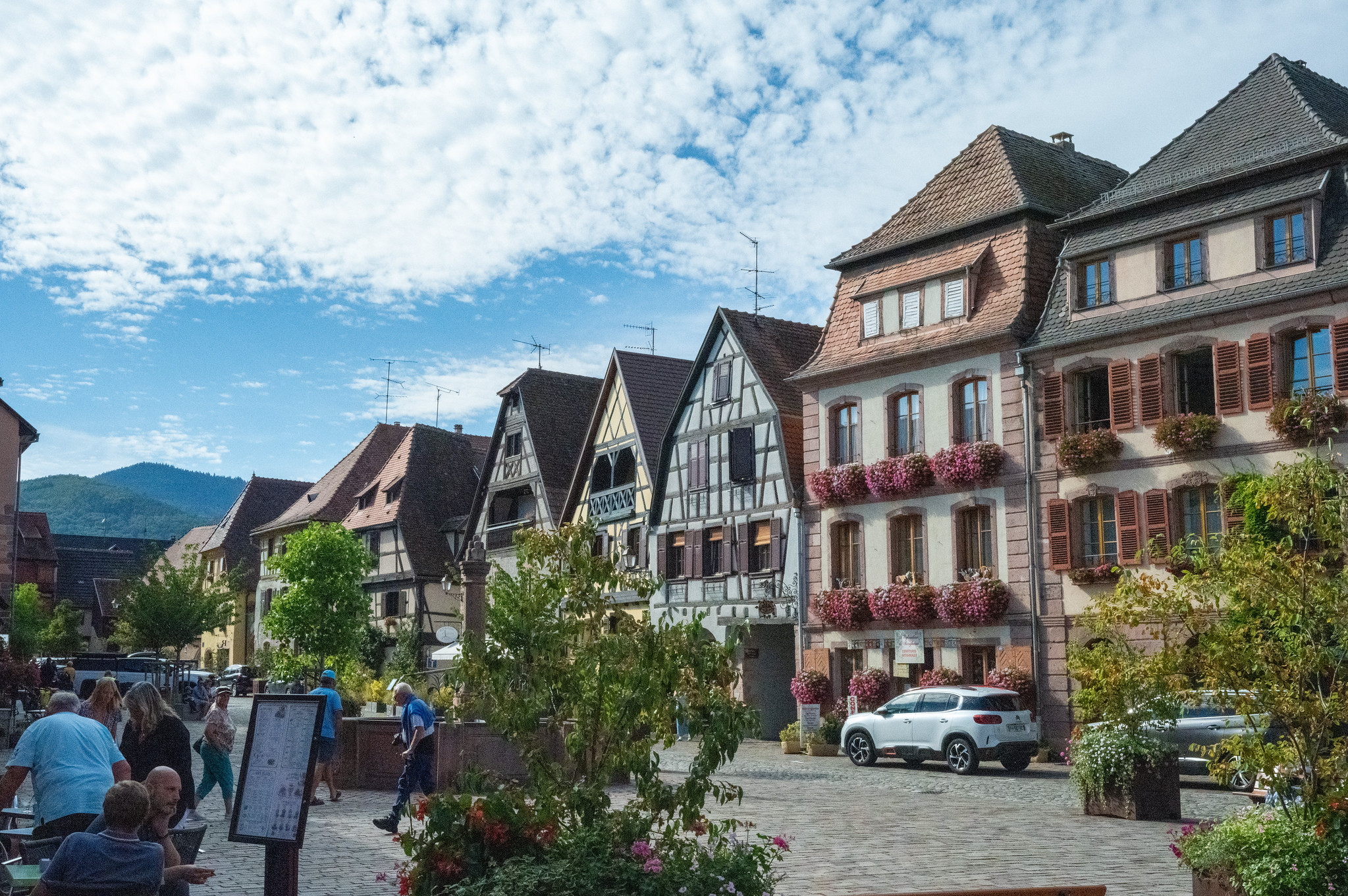
I had always felt that the beautiful villages of Alsace were, without exception, genuinely beautiful, and Bergheim proved no different. My immediate reaction was: “Yes—this is exactly what a beautiful village should feel like.” The reason I felt this so strongly was that Switzerland also has an association of its most beautiful villages, and we had visited several of them before reaching Bergheim. To be perfectly honest, quite a few had been disappointing, and I had begun to feel rather disheartened. Arriving in Bergheim gave me a powerful sense of reassurance—as if I had finally returned to the world of Les Plus Beaux Villages de France.
We spent approximately an hour walking around. One of the great qualities of the Most Beautiful Villages of France is their scale: they are neither too large nor too small, but just the right size for an enjoyable visit. Afterwards, we drove to Colmar, about twenty minutes away, and stayed there for the night.
Alsace offers so much to enjoy—beautiful scenery, excellent food and wonderful wine. I am sure that I will return many more times in the future.
For a detailed description of the village, please refer to the information below.
🌿 Summary
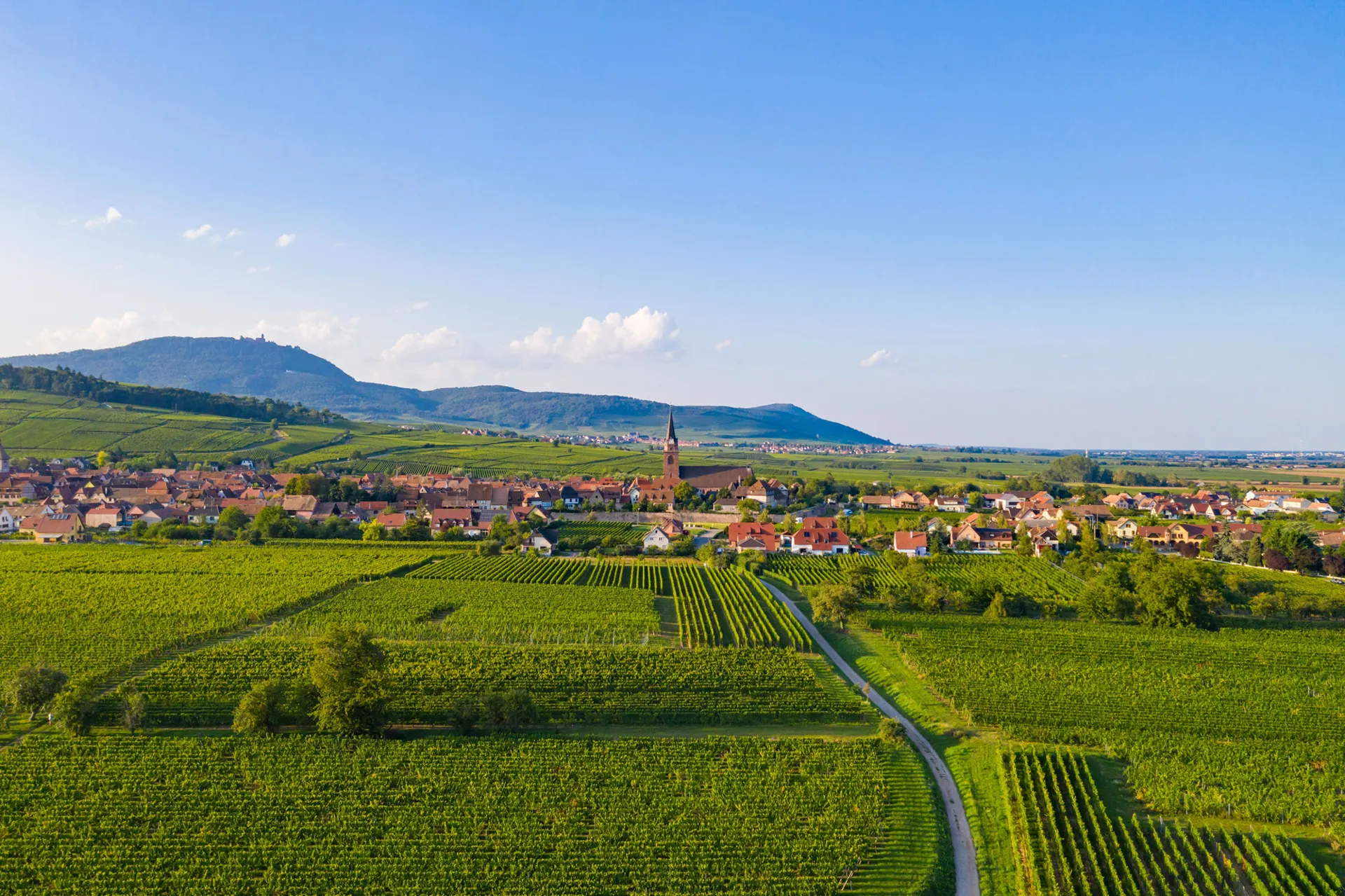
Bergheim is a remarkably well-preserved fortified wine village in the Haut-Rhin department of Alsace, between Colmar and Sélestat and close to Ribeauvillé. Surrounded by vineyards at the foot of the Vosges Mountains, it retains an almost complete medieval defensive enclosure, entered through the imposing Porte Haute. Inside the walls, flower-filled streets are lined with brightly painted half-timbered houses, Renaissance winegrowers’ residences and historic fountains. Bergheim is also distinguished by its celebrated vineyards, particularly the Altenberg de Bergheim and Kanzlerberg grands crus. It joined Les Plus Beaux Villages de France on 25 June 2022 and, only four days later, was voted France’s Favourite Village of 2022. :chatgpt-content-reference{index=”0″}
✨ Key Features
- An exceptionally well-preserved fortified village Bergheim is enclosed by approximately two kilometres of medieval ramparts, much of which can be followed on foot. Built and strengthened principally during the 14th century, the walls are accompanied by defensive towers and an outer moat that has been transformed into gardens. Few Alsatian wine villages have preserved their medieval fortifications so completely, making the circuit around the walls one of Bergheim’s most rewarding walks. :chatgpt-content-reference{index=”1″}
- The Porte Haute The Porte Haute, or *Obertor*, is the only survivor of the three gates that once controlled entry into Bergheim. Its massive rectangular tower, pointed passage and tiled roof create a dramatic entrance to the historic centre. After passing beneath it, visitors enter the long main street that crosses the village and leads toward the church and central square.
- Colourful Alsatian houses Within the ramparts, Bergheim contains a particularly harmonious collection of houses dating from the 15th to the 18th centuries. Timber framing, projecting upper storeys, carved beams and brightly coloured plaster façades reflect traditional Alsatian architecture. Many of the larger properties are former winegrowers’ houses, designed around courtyards where grapes could be pressed and wine stored.
- The Church of Notre-Dame-de-l’Assomption Bergheim’s parish church was built mainly between 1320 and 1347 in the Gothic style and subsequently altered during the 18th century. Important medieval features survive, including its vaulted choir, western bell tower and the sculpted Adoration of the Magi above the entrance. The church and several objects preserved inside it are protected as French historic monuments. :chatgpt-content-reference{index=”2″}
- The Maison des Sorcières The Maison des Sorcières, or Witches’ House, occupies a former school building dating from 1550. Its exhibition examines the witchcraft trials conducted in Bergheim and the surrounding district between 1582 and 1683. Rather than presenting witchcraft as folklore, the museum uses surviving historical records to explore persecution, intolerance, fear of outsiders and the particular vulnerability of women. :chatgpt-content-reference{index=”3″}
- The ancient dancing lime tree Near the ramparts stands Bergheim’s remarkable Tanzlinde, or dancing lime tree, traditionally dated to 1313. Trees of this kind once served as communal gathering places, sometimes with a wooden platform constructed among their branches for festivities and dancing. Recognised as an Arbre remarquable de France, it is an unusual living reminder of medieval civic life.
- A long tradition of refuge In 1313, Bergheim received the privilege known as the *droit d’asile*, or right of refuge. Under certain conditions, people accused of offences could seek temporary protection inside the fortified town. A fresco known as the Lack’mi, painted near the Porte Haute, is traditionally associated with this fiercely defended civic freedom and has become one of Bergheim’s more curious symbols. :chatgpt-content-reference{index=”4″}
- The Altenberg and Kanzlerberg vineyards Bergheim lies at the heart of the Alsace Wine Route and is surrounded by renowned vineyards. The Altenberg de Bergheim Grand Cru is particularly celebrated for complex, structured wines, often produced from several traditional Alsatian grape varieties. The much smaller Kanzlerberg Grand Cru is one of Alsace’s most distinctive vineyard sites. Gewurztraminer, Riesling and Pinot Gris are especially important locally. :chatgpt-content-reference{index=”5″}
- Jewish heritage and the former synagogue Bergheim supported a significant Jewish community for several centuries and was once the seat of a local rabbinate. The present synagogue was constructed between 1860 and 1863, replacing an earlier building destroyed by fire. No longer used regularly for worship, it serves as a cultural and exhibition space and preserves the memory of Jewish life in the village. :chatgpt-content-reference{index=”6″}
- Two major distinctions in 2022 Bergheim was admitted to Les Plus Beaux Villages de France on 25 June 2022, together with Beaulieu-sur-Dordogne, Martel and Rocamadour. On 29 June 2022, it was also proclaimed Le Village Préféré des Français, following a national public vote connected with the France 3 television programme. This unusual double recognition highlighted both the architectural quality of the village and the vitality of its community. :chatgpt-content-reference{index=”7″}
Bergheim combines the visual charm of an Alsatian wine village with an unusually rich and sometimes sombre history. Visitors can walk around its medieval ramparts, enter through the Porte Haute, admire its colourful houses and Gothic church, explore the history of the witchcraft trials and finish with a tasting of wines from the surrounding grand-cru vineyards. Compared with nearby Riquewihr, it generally feels quieter and less commercial, making it particularly pleasant to explore on foot.